
What Is a Payline in Slots?
Pull up almost any slot at a South African casino and you'll see a number staring back at you: 10 lines, 25 lines, sometimes 243 ways. Most players spin straight past it without a second thought. That's a mistake. Understanding what a payline is changes how you read every game on the screen—and more importantly, how much you're actually risking per spin.
Here's the thing: paylines aren't decoration. They decide whether three matching symbols pay you out or sit there meaning nothing. They quietly multiply your stake. They're the difference between a R1 bet and a R25 bet on the same game. Over the next few minutes, you'll learn how slot paylines work, how to read them on the reels, why more lines don't automatically mean better odds, and what "243 ways to win" really delivers. Let's get the foundation right.
★ Our Recommendations
| Welcome Package up to R2,000 + 300 Free Spins | Play | ||
| 100% up to R2,000 + 200 Free Spins | Play | ||
| 200% up to R5,000 + 300 Free Spins | Play |



What Is a Payline in Slots, Exactly?
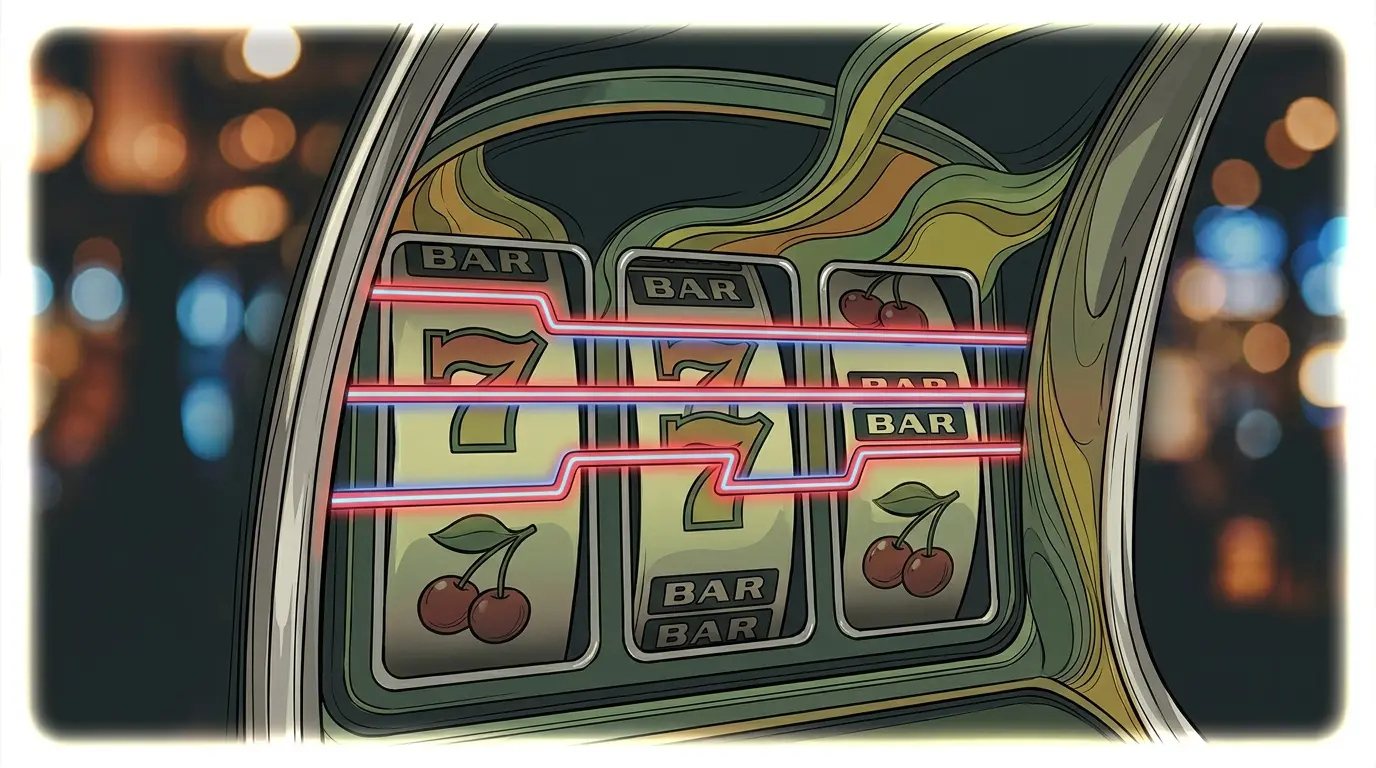
A payline is a defined pattern across the reels where matching symbols must land for you to win. Think of it as a pre-set path the game checks after every spin. Symbols only pay if they line up on an active payline. Land three matching icons scattered randomly across the screen, and on a standard payline game, you get nothing.
The classic slot had one line: straight across the middle. Modern games run dozens, zigzagging up, down, and diagonally. Each line is numbered, and the paytable shows you exactly where it runs.
What a payline actually does for you:
- Defines the winning path—usually left to right, starting from reel one
- Determines which symbol combinations count toward a payout
- Multiplies your stake (more active lines = bigger total bet)
- Lets you win on several lines from a single spin simultaneously
The shape matters less than the principle. Whether the line is flat or shaped like a V, the game only rewards symbols sitting precisely on that route. Everything else on the reels is just noise—until a scatter shows up, but more on that rule-breaker later.
How Winning Combinations Land on a Line
Winning combinations land when matching symbols hit consecutive reels along an active line—almost always reading left to right, beginning with the leftmost reel. Land matching symbols on reels one, two, and three along payline three? That line pays. Skip reel one, though, and most games won't count it, even if reels two, three, and four match perfectly.
This consecutive rule trips people up constantly. The symbols don't need to be on the same row—they follow whatever shape the payline traces. A diagonal line wants symbols stepping down through the reels. The paytable tells you what each combination pays, from three-of-a-kind up to a full five-reel match.
Why Paylines Shape Every Bet You Place
You're staring at a slot showing "R0.10" per line and you think you're betting 10 cents. Then you spin and R2.50 vanishes. What happened? The game had 25 active paylines, and that per-line figure gets multiplied across every single one. This is where most newcomers get caught out.
How slot paylines work with your bankroll matters more than almost any flashy feature. Your total bet is the per-line stake multiplied by active lines. That R0.10 across 25 lines is R2.50 a spin—and at fast play speed, that drains a budget quicker than people expect. In our experience watching new players, the ones who bust fastest are usually the ones who never checked their line count.
What paylines control on every spin:
- Your real cost per spin—per-line stake times active lines, not the small number you first see
- How often you hit something—more lines mean more frequent small wins, but they're often smaller than your total stake
- The "win that's actually a loss"—celebrate a R1.50 payout on a R2.50 spin and you've still lost money
- Pacing of your session—40 active lines burns through a budget far faster than 5
That last point catches even experienced players. A slot can show winning animations on most spins while your balance steadily shrinks. The screen flashes, coins jingle, and you feel like you're winning. The maths says otherwise. Always read the total bet figure—usually displayed separately from the per-line stake—before you commit. Knowing your true cost per spin keeps your expectations honest and the casino's edge in clear view.
Do More Paylines Actually Mean Better Odds?
No—and this is where plenty of guides get it wrong. More paylines don't improve your odds of winning overall. They change the shape of your results, not the underlying maths. The slot's RTP and the random number generator decide your long-term return regardless of how many lines fire.
What extra lines do is increase hit frequency. You'll land more small wins across more lines, but each spin costs proportionally more because you're funding every active line. So do more paylines mean better odds? Not for your bottom line. You're spreading the same bet across more paths—trading bigger, rarer wins for smaller, frequent ones. The house edge stays exactly where it was.
How Active Paylines Change Your Stake
Here's a quick calculation worth doing before every session: per-line bet × active lines = your real spend per spin. The maths is straightforward, but it's the maths people skip.
Set R0.20 per line on a 20-line slot and you're betting R4 every spin—not 20 cents. Drop to 10 active lines and you halve your cost to R2. On adjustable games, this is your throttle. Want a R200 budget to last? Calculate your spins: R200 ÷ R4 gives you just 50 spins. That disappears in two minutes at full speed. Adjust your lines and stake accordingly.
How to Read Slot Paylines on the Reels
Learning how to read slot paylines takes about five minutes and saves you from blind betting. Every slot hides this information in plain sight—you just need to know where to look. Follow these steps before you spin a real cent.
- Open the paytable or info screen. Look for an "i", a menu icon, or a "Paytable" button—usually bottom corner of the screen. This is your map for everything that follows.
- Find the payline diagrams. Most slots show numbered grids illustrating each line's path across the five reels. Line 1 might run flat through the middle; line 7 might zigzag top to bottom. Study the shapes.
- Check the win direction. Confirm whether wins pay left-to-right only, or both ways. Standard games start from reel one on the left—miss that reel and the combination usually won't count.
- Read the symbol values. The paytable lists each symbol's payout for three, four, and five matches. High-value symbols pay more; the card royals (10, J, Q, K, A) usually pay least.
- Locate your active line count. See how many lines are active and whether you can adjust them. On fixed-line slots, this number won't budge.
- Confirm your total bet. Find the total stake figure—separate from per-line value. This is your actual cost per spin. Burn this number into your brain.
- Spin a few times in demo mode. Watch which lines highlight on a win. Seeing the path light up makes the diagrams click in a way reading never does.
Reputable educational resources like Pokiescheck break down individual game paytables so you can verify these details before risking money. Once you've done this on three or four slots, reading paylines becomes second nature—you'll glance at a new game and instantly know your real exposure per spin.
Fixed Versus Adjustable Paylines
So what are fixed paylines? They're lines you can't switch off—every one is active on every spin, and you bet on all of them whether you like it or not. Adjustable paylines let you choose how many to activate, giving you control over your spend.
The trade-off is real. Fixed-line slots often offer that headline jackpot only when every line is in play, but they force a higher minimum bet. Adjustable games stretch a budget but may water down certain features.
| Feature | Fixed Paylines | Adjustable Paylines |
|---|---|---|
| Line control | All active, can't change | Choose how many |
| Minimum bet | Higher (all lines funded) | Lower (fewer lines) |
| Jackpot access | Usually always eligible | May need all lines active |
| Budget control | Less flexible | More flexible |
Where Scatter Symbols Break the Payline Rules
Forget everything about consecutive lines for a second—scatters don't care. They don't follow paylines at all. Land enough scatters anywhere on the reels, in any position, and they pay or trigger a bonus regardless of lines.
That's the whole point of a scatter. Three of them scattered across reels one, three, and five—positions that would never form a payline—still count. Most commonly they unlock free spins or bonus rounds. Some pay a direct multiplier on your total bet. Because they ignore line restrictions, scatters are often the symbols that deliver a slot's biggest features, which is exactly why the paytable lists them separately from standard symbols.
Smart Habits for Playing Multi-Line Slots
After tracking thousands of spins across dozens of multi-line games, one pattern stands out: the players who last longest treat line count as a budget tool, not an afterthought. Multi-line slots tempt you with constant action, but that action has a price tag attached to every line.
Habits worth building before your next session:
- Calculate total bet first, always. Per-line stake × active lines. Know your real cost before the reels move, not after.
- Match line count to your budget. Smaller bankroll? Fewer lines or lower per-line value. Don't let a flashy 40-line slot dictate your spend.
- Spot the fake wins. A payout smaller than your total stake is a net loss dressed up as a celebration. Track your balance, not the animations.
- Read the paytable for feature triggers. Know how many scatters launch free spins before you chase them blindly.
- Set a spin budget. Divide your bankroll by your total bet to see how many spins you actually get. If it's under 50, your stake's too high.
- Use demo mode to learn a game. Free play costs nothing and teaches you the payline behaviour before real money's on the line.
The goal isn't to win—no strategy beats the house edge long-term. It's to play longer, understand what you're risking, and keep entertainment as entertainment. Players who respect the line maths simply enjoy more spins for the same money.
What Does 243 Ways to Win Really Mean?
You'll see "243 Ways to Win" splashed across slots and wonder where that oddly specific number comes from. It means the game has scrapped traditional paylines entirely. Instead of fixed paths, any matching symbols on adjacent reels—starting from the leftmost reel—pay out, no matter which row they land on.
The 243 comes from simple maths. On a five-reel slot with three rows, each reel has three possible symbol positions. Multiply across all five reels: 3 × 3 × 3 × 3 × 3 = 243. That's every possible combination of positions forming a winning route. Land matching symbols anywhere on consecutive reels and you've hit a way to win.
This brings us to the difference between paylines and ways to win, which confuses plenty of players. Paylines require symbols on a specific, defined path—miss the shape and the win doesn't count. Ways-to-win games drop that restriction. Position within each reel stops mattering; only the consecutive-reel rule remains. Three matching symbols on the top of reel one, bottom of reel two, and middle of reel three? That pays on a 243 game, but might miss every payline on a traditional slot.
Some games push this further—1,024 ways (four rows) or the famous "Megaways" systems that can hit over 100,000 ways as reel heights shift each spin. More ways generally means more frequent wins, but the bet structure differs too. You typically pay one flat stake covering all ways, rather than funding individual lines. As always, the RTP—not the way count—determines your long-term return.
Why Some Modern Slots Have No Paylines
The newest generation of slots ditches lines completely, and there are solid reasons why. These cluster-pays and grid games reward groups of matching symbols touching each other—horizontally or vertically—rather than following any predetermined path. Land five or more identical symbols in a connected cluster and you win.
It's a cleaner experience. No diagrams to decode, no left-to-right rule to remember. Symbols often vanish after a win and new ones cascade down, chaining multiple payouts from a single spin. Game studios favour these mechanics because they feel fresh and reduce the confusion that scares off newcomers. The underlying maths still applies, though—the RTP and volatility govern your returns exactly as they do on a 25-line classic.
Strip away the jargon and paylines come down to one practical truth: they decide what you win and what you actually spend. Get that relationship clear and every slot on the screen becomes readable—you'll know your real cost per spin before you ever press the button. That single habit, calculating total bet versus per-line stake, separates players who understand the game from those just chasing flashing lights.
Apply this before your next session. Open the paytable, count your active lines, confirm your total stake, and match it to a budget you've set in advance. Whether you're playing 10 fixed lines, 243 ways, or a cluster-pays grid, the maths favours the house over time—so play for entertainment, set limits, and treat every spin as paid fun rather than an investment. From here, variance and RTP are the natural next concepts to master.