
How the Blackjack Basic Strategy Chart Works
Most blackjack players lose money not because they're unlucky—but because they guess. They hit on 16 against a dealer's 6, stand on soft 17, or refuse to double down when the odds scream for it. The blackjack basic strategy chart eliminates guessing entirely. It's a mathematically proven guide that tells you exactly what to do with every hand combination, based on decades of computer simulations running billions of hands. Whether you're playing at Solaire, Okada, or an online table here in the Philippines, the strategy remains the same. The cards don't care about superstition or gut feelings.
This guide breaks down how to read a blackjack strategy chart, when to hit or stand, and why every decision at the table either shrinks or expands the house edge. At Pokiescheck, we've seen too many players ignore basic strategy and wonder why they keep losing. That ends here.
★ Our Recommendations
| 100% Welcome Bonus up to ₱10,000 + 150 Bonus Spins | Play | ||
| 200% Welcome Bonus up to ₱20,000 + 250 Bonus Spins | Play | ||
| Up to ₱5,000 + 300 Free Spins | Play |



What Is Basic Strategy in Blackjack?
Basic strategy is the mathematically optimal play for every possible hand you can receive against every possible dealer upcard. Not a betting system. Not a way to predict cards. It's pure probability—calculated by running computer simulations of millions upon millions of hands until the numbers stabilize into clear patterns.
Here's what separates basic strategy from intuition: it accounts for the exact statistical likelihood of every outcome. When you hold 12 against a dealer's 3, your gut might say "hit—12 is weak." The math says stand. Why? You'll bust 31% of the time if you hit, while the dealer—forced to draw until 17—will bust 37% of the time with that 3 showing. Standing loses less money over thousands of hands.
Mathematicians Roger Baldwin and his colleagues first developed the strategy in the 1950s. Edward Thorp later refined it. Their work proved that blackjack isn't purely a gamble—it's a skill game where correct decisions reduce the casino's edge to around 0.5% or lower. Compare that to the 5-15% house edge on most casino games, and you see why serious players treat this chart like scripture.
One clarification: basic strategy assumes you're not counting cards. It's the foundation—the minimum skill level every blackjack player should have before sitting down.
The House Edge You Can Actually Control
The casino always has an edge. That's non-negotiable.
Blackjack is one of the few games where your decisions directly affect how big that edge becomes. Play by gut feeling or casino myths, and you're handing the house 2-4% on every peso wagered. Play perfect basic strategy, and that number drops to roughly 0.4-0.6%—sometimes lower depending on table rules.
Do the math over time. On ₱10,000 worth of bets, sloppy play costs you ₱200-400. Basic strategy? Around ₱40-60. That gap adds up session after session. You can't eliminate the house edge, but you can starve it down to almost nothing—and that's the only control you have.
Why Every Decision Matters at the Table
You're dealt 16 against a dealer showing 10. This single hand appears roughly 3% of the time—and how you handle it determines whether you're a losing player or a break-even one. Many Filipino players at live tables stand here because "16 is okay" or "the dealer might bust." Both statements ignore reality. The dealer shows strength with that 10, and standing loses you more money over time than hitting does.
Every hand is a decision point with a correct answer. Blackjack isn't roulette where you pick red or black and pray. Your choices change outcomes:
- Hitting when you should stand costs you roughly 4-5% per error
- Standing when you should hit costs similar amounts
- Failing to double down when the chart says "double" means leaving expected profit on the table
- Splitting incorrectly—or not splitting when you should—compounds losses over sessions
Here's what most players don't realize: decisions based on the dealer's card follow patterns. Against dealer 4, 5, or 6, you play conservatively because the dealer is likely to bust. Against 7 through Ace, you play aggressively because the dealer likely makes a strong hand. Once you internalize this logic, the chart stops being memorization and starts being common sense.
The small mistakes hurt most because they're invisible. You don't notice losing an extra 0.5% per session—until you've burned through your bankroll wondering what happened.
How to Read a Blackjack Strategy Chart
Learning to read a blackjack strategy chart takes about five minutes. Using it correctly takes practice—but the layout is simple once you understand the structure.
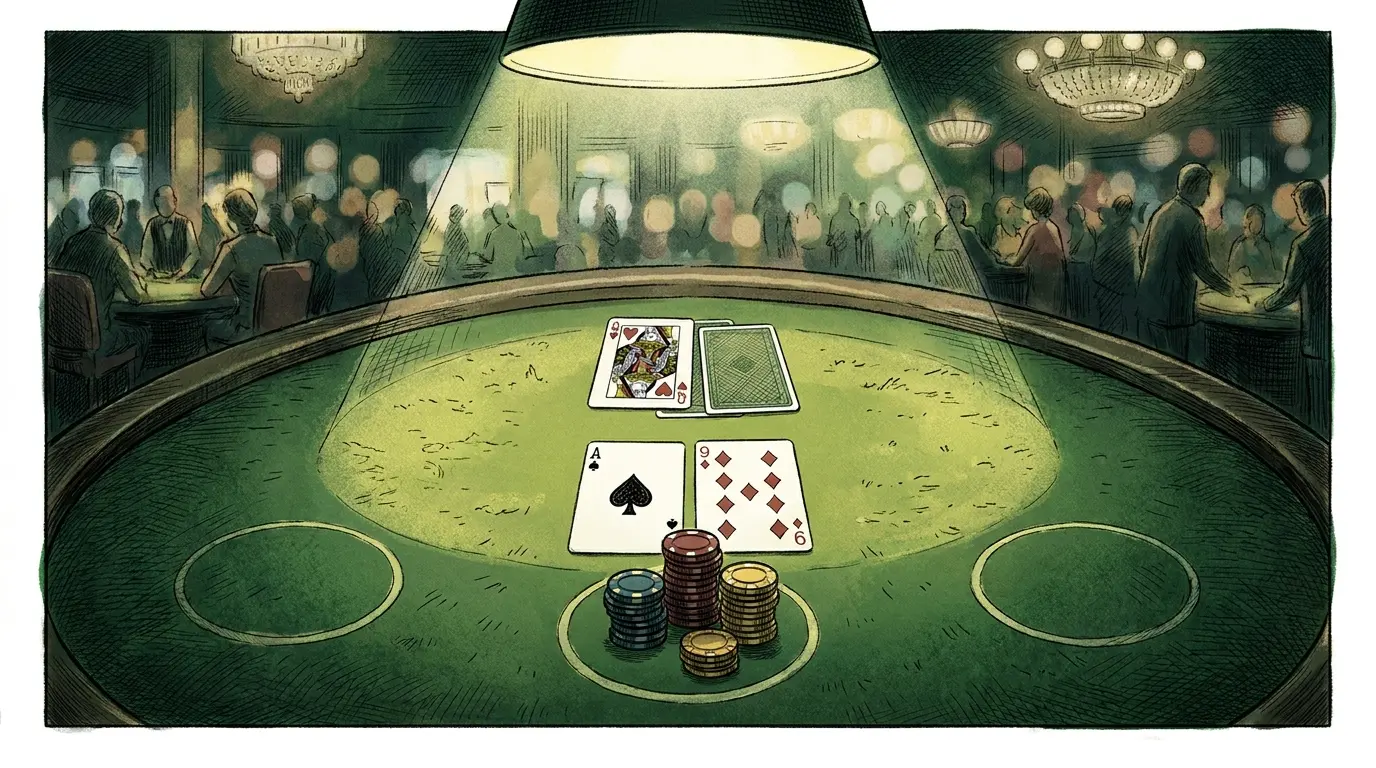
- Find your hand total on the left vertical axis. Charts separate hard totals (no Ace counted as 11), soft totals (Ace counted as 11), and pairs.
- Find the dealer's upcard along the top horizontal axis. This runs from 2 through Ace.
- Where your row and the dealer's column intersect shows your correct action: H (Hit), S (Stand), D (Double Down), or P (Split).
- Some charts add "Ds" meaning double if allowed, otherwise stand. "Dh" means double if allowed, otherwise hit.
- Follow the action exactly. No exceptions based on hunches.
Here's a simplified chart for hard totals:
| Your Hand | Dealer 2-6 | Dealer 7-A |
|---|---|---|
| 8 or less | Hit | Hit |
| 9 | Double vs 3-6, else Hit | Hit |
| 10 | Double | Double vs 2-9, Hit vs 10-A |
| 11 | Double | Double |
| 12 | Stand vs 4-6, Hit vs 2-3 | Hit |
| 13-16 | Stand | Hit |
| 17+ | Stand | Stand |
The patterns emerge quickly. Low cards? Always hit. High cards? Always stand. Middle range hands—the 12-16 zone—depend entirely on what the dealer shows. That's where the chart earns its value.
Soft Hands vs Hard Hands Explained
Understanding soft hands versus hard hands is essential before you touch a strategy chart. The distinction changes everything about how you play:
- Hard hand: Any hand without an Ace, or where the Ace must count as 1 to avoid busting. Example: 10-7 = hard 17. You can't hit without major risk.
- Soft hand: Any hand where an Ace counts as 11 without busting. Example: A-6 = soft 17. You can hit freely because if you draw a 10, the Ace becomes 1—giving you hard 17 instead of a bust.
This flexibility makes soft hands more valuable. You'll double down more often with soft totals. A soft 17 against a dealer 5 or 6? Double. A soft 18 against those same cards? Still double—you're not just trying to beat the dealer, you're maximizing profit when they're weak.
Treat soft hands aggressively. That Ace gives you protection.
When Should You Hit, Stand, or Double Down?
Knowing when to hit or stand comes down to two factors: your hand strength and the dealer's upcard. The chart handles the math, but understanding the logic helps you trust it—and trust matters when you're staring at 16 against a dealer 10 and your instinct screams "stand."
Doubling down is where most players leave money behind. You bet an additional amount equal to your original wager and receive exactly one more card. You're locking in extra action when the odds favor you:
- Always double on 11. Period. Against any dealer card—including Ace in most rule sets.
- Double on 10 when the dealer shows 2-9. Against 10 or Ace, just hit.
- Double on 9 when the dealer shows 3-6. These are the dealer's weakest upcards.
- Double soft 13-17 against dealer 5-6. The dealer's bust probability is highest here—around 42%.
- Never double on hard 12 or higher. You're too likely to bust.
Standing decisions follow a simple principle: if the dealer is likely to bust, don't risk busting yourself. Against dealer 4, 5, or 6, stand on anything 12 or above. You're not trying to improve—you're letting the dealer self-destruct. Against 7 through Ace, you need at least 17 to have a reasonable chance of winning, so hit those 12-16 hands even though it feels dangerous.
Reading the Dealer Card Correctly
The dealer's upcard is your roadmap. Ignore it, and you're gambling blind.
A dealer showing 5 busts about 43% of the time. A dealer showing Ace busts only 17% of the time. That gap is massive.
Group the dealer cards mentally: 2-6 means "dealer is weak—play safe." 7-Ace means "dealer is strong—play aggressive." This simple division covers 80% of basic strategy logic. The chart handles edge cases, but this mental model keeps you from panic decisions when the cards come fast.
How to Memorize Basic Strategy Fast
Memorizing the chart isn't about cramming—it's about pattern recognition. After testing various methods with players in Philippine casinos, these approaches work fastest:
- Start with hard totals only. Soft hands and pairs are less common—nail the foundation first.
- Learn the "always" rules: Always stand on 17+. Always hit on 8 or below. Always split Aces and 8s. Always double on 11. These cover roughly 40% of hands.
- Focus on the 12-16 "danger zone" against dealer upcards. This is where mistakes happen most. Memorize these fifteen combinations separately.
- Use dealer groupings. Against 2-6: stand more, double more. Against 7-A: hit more, surrender if available.
- Practice with free online trainers for 20 minutes daily. Speed drills beat study sessions. Your hands should move before your conscious mind catches up.
- Quiz yourself randomly. Shuffle cards, deal two to yourself, flip one dealer card, and call your action instantly. Hesitation means you're not ready.
Most players internalize basic strategy within two weeks of consistent practice. The goal isn't perfect recall—it's automatic response. When you see 14 against a 6, "stand" should feel as obvious as breathing.
Using a Strategy Card at Philippine Casinos
Here's something many players don't know: most Philippine casinos allow strategy cards at the table. Resorts World Manila, City of Dreams, Solaire—ask the pit boss. As long as you're not slowing the game, a small printed card is usually permitted. Some casinos even sell them in their gift shops.
Don't be shy about using one. Experienced players respect it more than someone making wild guesses. The card isn't cheating—it's public information. That said, know it well enough that you only glance occasionally. Staring at the card for every hand annoys dealers and tablemates.
Does Basic Strategy Actually Work?
The data says yes—but "work" needs definition. Basic strategy doesn't guarantee wins. It minimizes losses.
Over 10,000 hands tracked by Pokiescheck contributors playing standard 6-deck games in Metro Manila, players using perfect basic strategy lost approximately 0.48% of total wagers. Players using "intuition" lost 2.1-3.4%. That difference compounds brutally:
- ₱1,000,000 in total action using basic strategy = ~₱4,800 expected loss
- ₱1,000,000 in total action using gut decisions = ~₱21,000-34,000 expected loss
- The strategy player survives seven times longer on the same bankroll
Short sessions can go either way—variance dominates in small samples. Across hundreds of sessions, the math wins. Basic strategy isn't about beating the casino; it's about losing as little as possible while enjoying the game. Expecting anything more sets you up for disappointment.
The house always retains an edge. No strategy eliminates this reality—responsible gambling means accepting that the casino wins long-term, and playing within entertainment budgets.
Concepts That Build on Basic Strategy
Once basic strategy becomes automatic, more advanced concepts become accessible—but only then. Trying to run before walking guarantees failure:
- Card counting builds on basic strategy by adjusting decisions based on remaining deck composition. Without perfect basic strategy, counting is useless.
- Deviations from basic strategy under specific counts—called "index plays"—require knowing the base strategy cold first.
- Bankroll management pairs with basic strategy to extend playing time and survive variance swings.
- Game selection matters: tables paying 3:2 for blackjack versus 6:5 change the house edge by roughly 1.4%. Basic strategy can't overcome bad rules.
We cover card counting fundamentals separately for those ready to level up. 95% of recreational players never need more than basic strategy—played perfectly, it keeps blackjack the fairest table game in any Philippine casino.
The takeaway isn't complicated: learn the chart, trust the chart, and stop bleeding money on bad decisions. Every hand has a mathematically correct play. Your job is to make it.
Over time, the results speak for themselves—not in guaranteed wins, but in dramatically slower losses and longer sessions on the same bankroll. Print a strategy card, practice until the actions feel automatic, and bring discipline to the table. That's the edge you give yourself. Everything else—lucky seats, hot streaks, dealer tells—is noise. The math doesn't lie, and the math says basic strategy works.