
What Are the Rules of Baccarat?
Walk into any casino in Dar es Salaam or open a live dealer table online, and baccarat looks intimidating—players betting fast, cards flipping, two hands going head to head. But here's the truth: baccarat rules are simpler than almost any card game you'll meet. You don't make decisions about hitting or standing. You don't read other players. You bet on one of three outcomes and watch it unfold.
That simplicity is exactly why it's worth learning properly. In my years teaching players around Tanzania, I've watched newcomers lose money not because the game is hard, but because nobody explained the basics. This guide covers how baccarat works, what each bet really means for your money, how cards are counted, and the habits that keep your bankroll alive. By the end, you'll understand the game better than half the people sitting at the table.
★ Our Recommendations
| Up to TSh200,000 + 200 Free Spins | Play | ||
| Welcome Package up to TSh50,000 + 150 Free Spins | Play | ||
| Welcome Package up to TSh50,000 + 50 Free Spins | Play |



What Is Baccarat and How Does It Work?
Baccarat is a card game where you bet on which of two hands—the Player or the Banker—will land closest to a total of nine. That's the whole goal. You're not playing against other gamblers, and despite the names, you don't have to bet on the "Player" hand just because you're a player.
Here's how baccarat works at its core: the dealer deals two hands from a shoe of cards. Each hand gets two cards to start. The totals are added up using a special counting method, and whichever side sits closer to nine wins. Sometimes a third card gets drawn under fixed rules—but you never decide that. The rules do.
What surprises most beginners? You have zero control over the cards. No skill in drawing, no strategy in playing the hand. Your only job is choosing where to place your chips before the deal. That makes baccarat a game of pure probability dressed up in elegance.
The reputation for being a "high roller" game scares people off. Don't let it. Online tables at platforms reviewed by Pokiescheck let you bet small while you learn the rhythm.
Reading the Baccarat Table Layout
The baccarat table layout looks busy at first, but it's organized around three simple bets repeated for each seat. Once you spot the pattern, it's easy.
- Player betting box: Where you place chips if you think the Player hand wins. Pays even money (1:1).
- Banker betting box: Your spot for backing the Banker hand. Pays even money minus a small commission, usually 5%.
- Tie betting box: Sits between the two, for betting both hands finish equal. Tempting payouts, dangerous odds.
- Numbered seats: On a full table, each player has their own set of these three boxes.
- Commission area: The dealer tracks Banker commission here in physical games—online it's automatic.
That's it. Three choices, clearly marked. Everything else on the felt is just decoration or seat numbers.
Why the Three Betting Options Matter to You
Three bets. That's all baccarat offers—and the difference between them decides whether you bleed money slowly or quickly. This is where understanding house edge separates smart players from hopeful ones.
Every bet carries a built-in advantage for the casino. The math never changes, no matter how long you sit there. What changes is how much that edge costs you per hand. The Banker bet is the cheapest. The Tie is the most expensive by a wide margin. And honestly, most guides bury this fact when it should be the first thing you learn.
Look at the numbers across thousands of hands tracked in standard eight-deck games:
| Bet Type | Payout | House Edge | Win Probability |
|---|---|---|---|
| Banker | 1:1 (minus 5% commission) | 1.06% | 45.86% |
| Player | 1:1 | 1.24% | 44.62% |
| Tie | 8:1 (sometimes 9:1) | 14.36% | 9.52% |
See the gap? The Banker bet costs you about 1 shilling per 100 wagered over the long run. The Tie costs roughly 14. That's not a small difference—it's the difference between a session that lasts an hour and one that ends in ten minutes.
Here's the thing: the house edge always wins eventually. No betting system changes that. But choosing the right bet stretches your money and your playing time. Understanding this keeps expectations realistic—you're paying for entertainment, not earning a salary.
Player Bet vs Banker Bet: Which Is Smarter?
The player bet versus banker bet debate has a clear winner on paper: the Banker. It wins more often—about 45.86% of hands compared to 44.62% for the Player—because of how the third card rules favor it.
"But the commission!" people say. Yes, the Banker bet charges roughly 5% on wins. Even after that cut, it remains the lowest-edge bet on the table at 1.06% versus the Player's 1.24%.
So what is the Banker bet in baccarat really? It's the mathematically smartest single wager in the entire game. If you played nothing but Banker every hand, you'd lose money slower than any other approach.
That said—the difference is tiny over a short session. For casual play, either bet is fine. Just never convince yourself the Player bet is "due" to win. Cards have no memory.
Is the Tie Bet Ever Worth Taking?
What is the Tie bet in baccarat? It's the wager that both hands finish with identical totals—and it's the worst value on the table. The 8:1 payout looks juicy until you see the 14.36% house edge behind it.
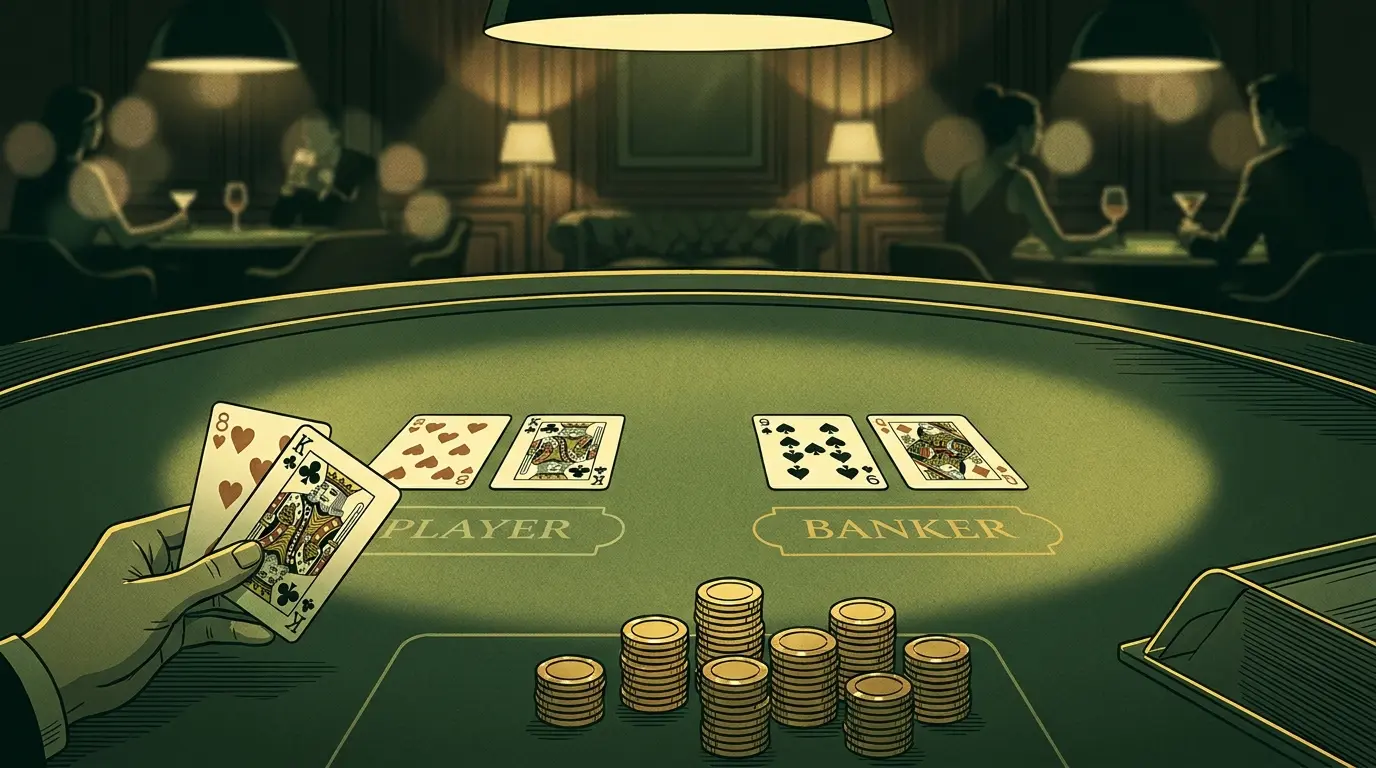
Think about it practically. A tie happens roughly once every ten or eleven hands. The payout doesn't come close to compensating for those odds. Over time, the Tie bet drains bankrolls faster than anything else in baccarat.
My honest take after watching countless beginners chase it? Skip it. The occasional big payout feels great, but the math guarantees you'll give it all back and more. Treat the Tie as a sucker bet and move on.
How a Baccarat Round Plays Out Step by Step
You've placed your bet—now what? Learning how to play baccarat means understanding the sequence, even though you control none of it after betting. Here's exactly how a round unfolds from start to finish.
- Place your bet. Before any cards appear, you put chips on Player, Banker, or Tie. Once the dealer calls "no more bets," you're locked in.
- The deal begins. The dealer draws two cards for the Player hand and two for the Banker hand, dealing them face up in alternating order from the shoe.
- Totals are calculated. Each hand's value is added using baccarat counting—only the last digit of the total counts. A 7 and 8 (15) becomes 5.
- Check for a natural. If either hand totals 8 or 9 from the first two cards, that's a "natural." The round ends immediately and the higher hand wins. No third card.
- Player hand third card rule. If no natural appears, the Player hand draws a third card when its total is 0 through 5, and stands on 6 or 7.
- Banker hand third card rule. The Banker draws based on a fixed table that depends on its own total and the Player's third card. This is automatic—nobody decides.
- Compare and settle. Whichever final hand sits closest to nine wins. Winning bets get paid, losing chips are collected, and Banker wins pay the small commission.
- Next round. The shoe continues until it's depleted, then cards are reshuffled.
Notice how little you do? After step one, you're a spectator. That's the beauty and the catch—baccarat rewards bet selection, not gameplay skill. In a live online round, all of this happens in under a minute, which is why bankroll discipline matters so much. Hands fly by fast, and losses pile up before you notice if you're not paying attention.
How Card Values Are Counted in Baccarat
Understanding how card values are counted in baccarat takes about thirty seconds, and it's the one rule that trips up every beginner the first time they see a total drop.
- Cards 2 through 9: Worth their face value. A 7 is seven points, a 4 is four.
- Tens and face cards: Kings, Queens, Jacks, and 10s all count as zero.
- Aces: Always worth one point.
- The drop rule: When two cards total more than nine, you drop the first digit. A 9 and 6 equals 15—but it counts as 5.
- Highest possible total: Nine. You can never "bust" like in blackjack.
That dropping rule is the whole trick. A hand of 8 and 8 (16) becomes 6, not a winner. Get this down and the rest of baccarat clicks into place.
When Does the Third Card Rule Apply?
When does the third card rule apply in baccarat? Only when neither hand shows a natural 8 or 9, and the totals fall within specific ranges that trigger an automatic draw. You never make this call—the dealer or software follows a fixed chart.
For the Player hand, it's straightforward: a total of 0 to 5 draws a third card, while 6 or 7 stands. Once the Player's situation resolves, the Banker follows its own rules.
The Banker's third card logic depends on two things—its current total and what third card the Player drew, if any. For example, a Banker total of 3 draws unless the Player's third card was an 8. A Banker total of 6 only draws if the Player's third card was a 6 or 7. It looks complicated written out, but you'll never need to memorize it.
Why does this matter to you? Because these rules are exactly why the Banker bet wins slightly more often. The Banker acts second with more information, giving it a structural edge baked into the game.
Smart Habits That Keep Your Bankroll Safe
You're up 50,000 TZS after fifteen minutes. Should you keep going? The answer separates players who walk away with money from those who donate it all back. There's no system to beat baccarat—but there are habits that protect you.
- Set a session budget before you sit down. Decide what you can afford to lose, and treat it as the cost of entertainment—not an investment.
- Stick to the Banker bet. At 1.06% house edge, it's the slowest way to lose. Boring? Maybe. Effective? Absolutely.
- Ignore betting systems. Martingale, Fibonacci, the lot—none of them change the house edge. They just rearrange when you lose.
- Skip the Tie bet entirely. That 14.36% edge is a money shredder dressed up in a tempting payout.
- Set a win goal and a loss limit. Hit either one, and you stop. No exceptions, no "one more hand."
- Watch the clock, not the cards. Hands move fast online—a fixed time limit prevents the tunnel-vision losses I've seen ruin too many sessions.
- Never chase losses. Doubling your bet to "win it back" is the fastest route to an empty account. In my experience, chasers bust within a few sessions.
Asking how to win at baccarat misses the point. Nobody wins long-term against a built-in house edge. The realistic goal is stretching your entertainment, enjoying the rhythm of the game, and walking away while you still have chips. Pokiescheck consistently emphasizes this approach because it's the only one grounded in honest math.
Common Baccarat Terms Every Beginner Should Know
Sitting at a table without knowing the language feels uncomfortable. Here are the common baccarat terms explained simply, so you sound—and play—like someone who belongs.
- Banker: One of the two hands you can bet on. Not the casino, not you—just a label.
- Player: The other hand. Again, just a name, not necessarily "your" hand.
- Natural: A two-card total of 8 or 9. It ends the round instantly.
- Shoe: The box holding the multiple decks the dealer draws from—usually six or eight decks.
- Commission: The 5% fee on winning Banker bets that balances its higher win rate.
- Standoff: Another word for a tie, when both hands match in total.
- Coup: A single complete round of baccarat from deal to payout.
- Punto Banco: The most common version played worldwide, where all draws follow fixed rules.
- Baccarat: Ironically, a total of zero—the worst possible hand.
Master these and the table chatter stops sounding foreign. You'll follow every coup without second-guessing what just happened.
The biggest mindset shift for any beginner is this: baccarat isn't a game you outsmart—it's one you understand and enjoy responsibly. Stick to the Banker bet, avoid the Tie, set firm limits, and you'll get far more entertainment per shilling than the player chasing systems beside you.
Put what you've learned to use by starting small and watching a few rounds before betting—even free demo tables teach the rhythm without risk. Once the third card rules and counting feel natural, the whole game slows down in your mind. From here, exploring house edge across different casino games or digging into bankroll strategy makes for a smart next step. Play it as entertainment, keep your limits honest, and baccarat becomes one of the most relaxing games on the floor.