
Paylines in Pokies Guide
Here's a scenario: you've just landed three matching symbols on your favourite pokie, but nothing happens. No payout, no celebration—nothing. What went wrong? Those symbols weren't sitting on an active payline. Understanding what a payline is in pokies is genuinely one of the most overlooked fundamentals among Kiwi players. After tracking thousands of spins across dozens of games, the Pokiescheck team noticed a clear pattern—players who understand paylines make smarter betting decisions and stretch their bankrolls further.
This guide breaks down payline meaning in plain terms. You'll learn how paylines actually determine your wins, the real difference between fixed and adjustable systems, and whether chasing more paylines actually improves your odds. No fluff, no sales pitches—just the mechanics every player should know before their next session.
★ Our Recommendations
| Welcome Package up to NZ$200 + 150 Free Spins | Play | ||
| Get 150 Free Spins + 200% up to NZ$300 | Play | ||
| Up to NZ$750 + 150 Free Spins | Play |



What Is a Payline in Pokies?
A payline is the predetermined pattern across the reels where matching symbols must land for you to receive a payout. Think of it as an invisible line drawn across the game grid—when the right combination of symbols aligns along that exact line, you've got yourself a winning payline.
On classic three-reel pokies, there might be just one horizontal payline running through the middle row. Modern video pokies? Completely different story. These games can feature anywhere from 10 to 100+ paylines zigzagging across the screen in patterns you'd never predict just by looking.
Here's what most players miss: symbols landing anywhere on the reels don't automatically count. They must fall on an active payline—one you've actually bet on—to trigger a win. You could have five identical symbols scattered across the screen, and without a payline connecting them, you get nothing.
The paytable shows every payline's shape and direction. Some run left to right exclusively. Others pay both ways. Some newer games have abandoned traditional paylines entirely—but we'll get to that distinction later.
Classic Straight Lines vs Modern Patterns
Classic pokies kept things simple: straight horizontal lines, usually one to five of them. You could literally see where wins would form just by glancing at the screen.
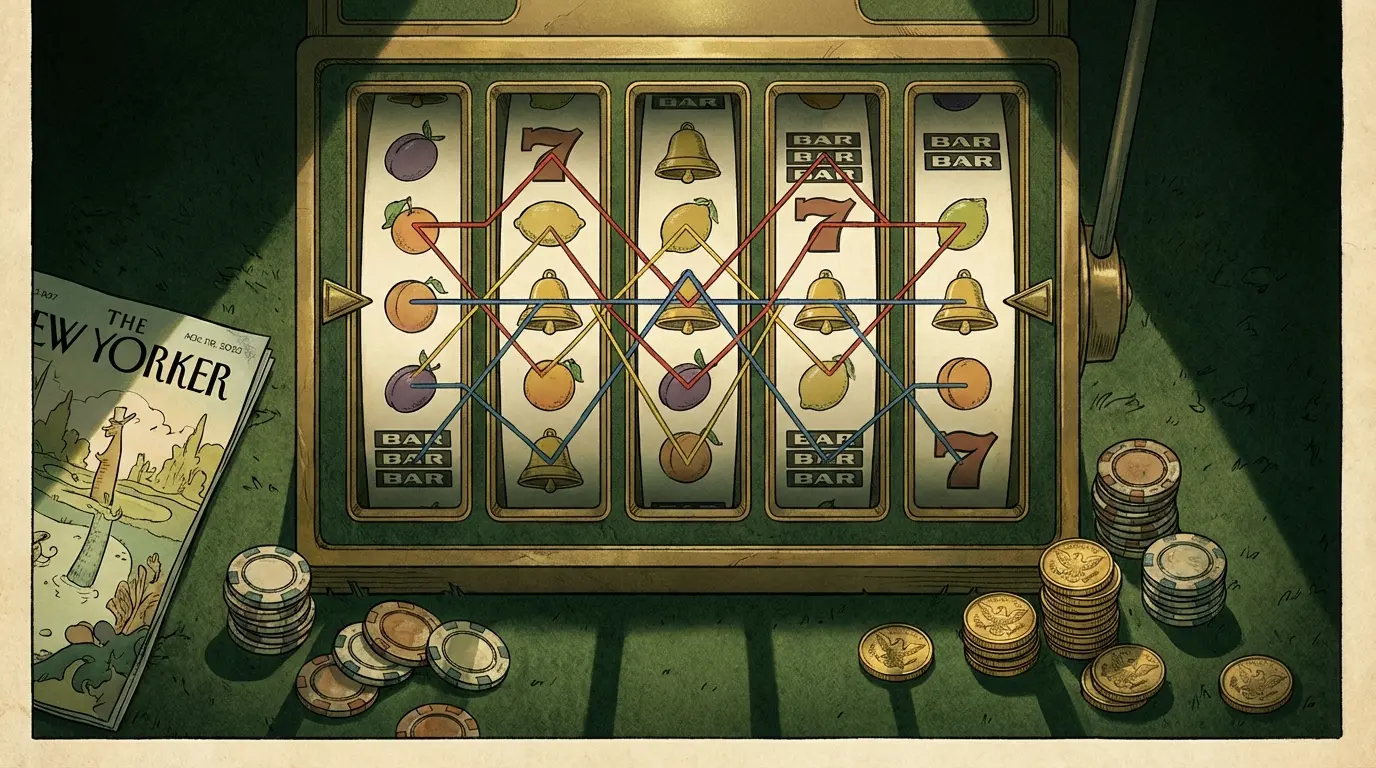
Modern pokies threw that simplicity out the window. Today's payline shapes include:
- Diagonal lines cutting corner to corner across five reels
- V-shapes and inverted V-shapes spanning the grid
- Zigzag patterns that bounce between rows unpredictably
- W-formations and other geometric configurations
- Cascading patterns that start high, dip low, then rise again
These complex shapes aren't just visual flair—they create more winning possibilities per spin. The trade-off? You're often betting on all of them simultaneously, which affects your total stake.
Why Paylines Matter for Your Pokie Sessions
Paylines directly control two things that should concern every player: how often you can win and how much each spin costs. Miss this connection, and you're flying blind with your bankroll.
Consider the maths. A pokie with 25 paylines at $0.02 per line costs $0.50 per spin. That same game with only 10 lines active drops to $0.20. Over 500 spins, that's the difference between $250 and $100 wagered. The house edge applies to your total bet—so more paylines mean more money exposed to that edge per session.
The catch? Reducing active paylines doesn't just save money; it reduces your chances of hitting winning combinations. That three-of-a-kind might land on payline 18—and if you've only activated paylines 1-10, tough luck. You'll see the symbols align without receiving a cent.
Payline calculations work like this: every active line gets evaluated after each spin. The game checks each payline independently, comparing symbol positions against the paytable requirements. Multiple paylines can win simultaneously on a single spin—which is why those rare multi-line hits feel so satisfying.
Understanding this trade-off between coverage and cost is fundamental. There's no universal right answer; it depends on your goals for that session and what your bankroll can sustain.
How Do Paylines Actually Work on Pokies?
Payline mechanics aren't complicated once you see the sequence. Every spin follows the same evaluation process, regardless of whether you're playing a 9-payline classic or a 243-ways monster.
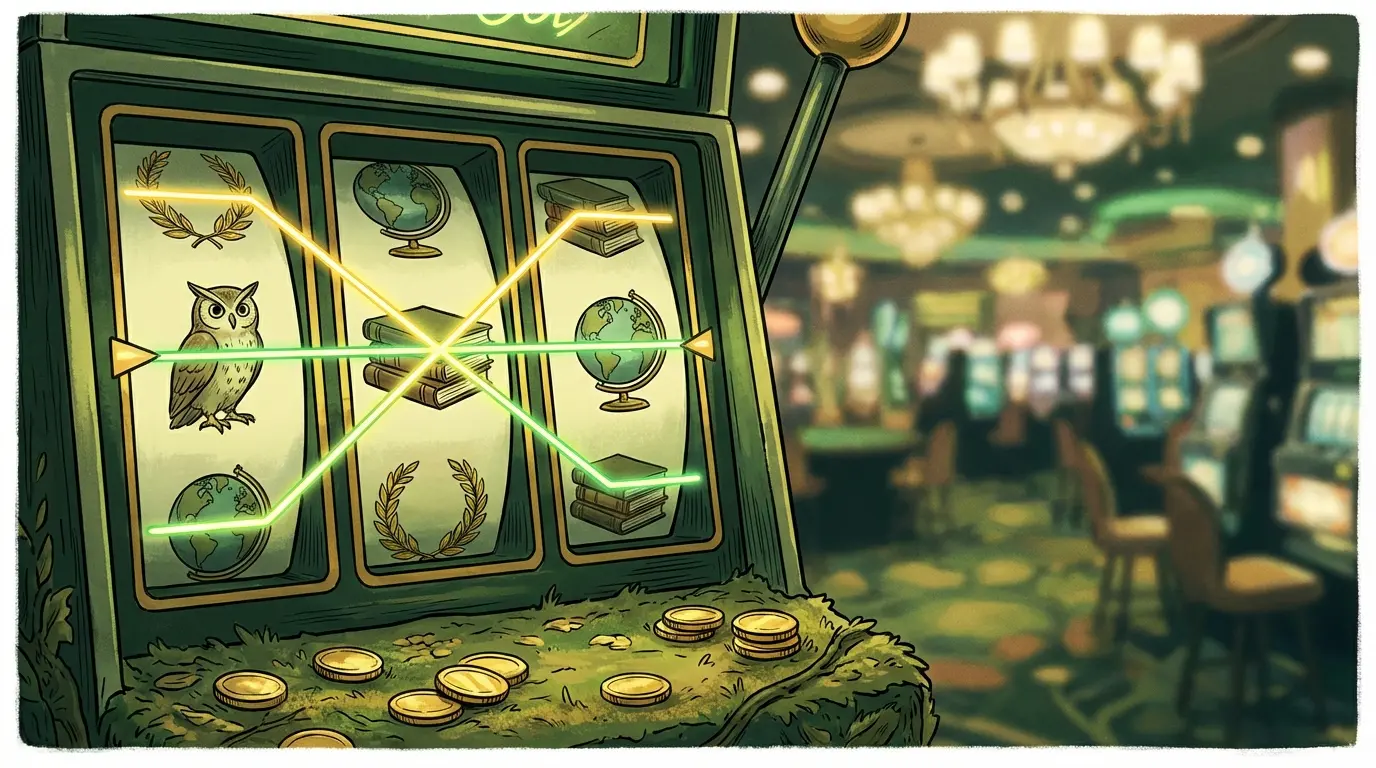
- You place your bet: This includes selecting how many paylines (if adjustable) and your coin value per line. Your total bet equals paylines multiplied by coin value—a 25-line game at $0.10 per line costs $2.50 total.
- The reels spin and stop: A random number generator determines each reel's stopping position. Despite appearances, the outcome is decided the moment you hit spin—the animation is just for show.
- The game maps symbol positions: Each symbol's location gets recorded against the grid. On a standard 5x3 layout, that's 15 symbol positions to evaluate.
- Paylines are checked sequentially: The software examines each active payline, starting from payline 1. It looks for matching symbols beginning from the leftmost reel (unless the game pays both ways).
- Winning combinations are identified: For each payline, if three or more consecutive matching symbols appear from left to right, that payline wins. The paytable determines the payout amount based on symbol value and quantity.
- Payouts are calculated and combined: Wins from all paylines are added together. If payline 7 paid $5 and payline 19 paid $2, you'd receive $7 total. This is how multiple simultaneous wins work.
- Special symbols are evaluated: Wilds substitute for missing symbols to complete paylines. Scatters typically don't require payline alignment—they pay based on total appearances anywhere on screen.
The entire process happens instantly. What looks like reels spinning is actually a predetermined result being animated for entertainment value.
How to Read Paylines on Any Pokie Screen
Before betting actual money, always check the paylines through the game's information screen. Every legitimate pokie displays this clearly—you just need to know where to look.
- Access the paytable via the "i" button, menu icon, or "help" option—usually bottom-left of the screen
- Navigate to the paylines section, often shown as numbered lines overlaid on a blank reel grid
- Note the direction each payline travels—most pay left-to-right only, but some games pay both ways
- Observe where each payline starts and ends—this tells you which reel positions matter for that specific line
- Look for colour-coding that matches during actual gameplay, helping you identify which line triggered a win
Many pokies briefly highlight the winning payline after each successful combination. Watching for this animation helps you understand which patterns are actually paying out during your session.
Fixed vs Adjustable Paylines Explained
Fixed versus adjustable paylines represents a fundamental design choice that directly affects your betting flexibility. Neither system is inherently better—they just suit different playing styles.
Fixed paylines mean every line is always active. You can't deselect payline 17 or choose to only play lines 1-10. Your choice comes down to coin value alone. Game developers increasingly favour this approach because it ensures players can't accidentally reduce their winning potential by deactivating lines where bonus symbols might land.
Adjustable paylines give you control over line selection. You might play all 25 lines, just the central 5, or even a single horizontal payline. This flexibility lets you manage spin costs precisely—but it carries risk. Deactivating lines means potential wins literally bypassing your active coverage.
| Feature | Fixed Paylines | Adjustable Paylines |
|---|---|---|
| Line selection | All lines always active | Player chooses which/how many |
| Cost control | Adjust coin value only | Adjust both lines and coin value |
| Win potential | Maximum coverage every spin | Depends on lines selected |
| Minimum bet | Typically higher | Can be very low (1 line, minimum coin) |
| Common in | Newer video pokies, popular titles | Classic-style games, older releases |
Game providers like Microgaming and NetEnt have largely shifted toward fixed paylines in their flagship releases. You'll still find adjustable options in retro-themed games or pokies targeting budget-conscious players.
Do More Paylines Give You Better Odds?
This is where most guides get it wrong. More paylines don't improve your odds the way players typically assume.
More paylines increase your hit frequency—you'll land winning combinations more often because you're covering more patterns. But each spin also costs more. The house edge, typically 3-6% on quality pokies, applies to your total bet regardless of payline count.
Here's a concrete example. Playing 10 paylines at $0.10 each ($1 total bet) versus 50 paylines at $0.02 each ($1 total bet) exposes identical amounts to the house edge. You'll hit wins more frequently on the 50-line game, but those wins will be proportionally smaller because your per-line stake is lower.
RTP percentages assume all paylines are active. Playing fewer lines on an adjustable game might actually reduce your effective RTP—though exact impact varies by game design.
How Many Paylines Should You Play?
The right number of paylines depends entirely on your session goals and bankroll reality. There's no magic number that works for everyone—anyone claiming otherwise is oversimplifying.
Consider these factors before each session:
- Your total bankroll: If you've allocated $50 for the session, playing $2.50 per spin (all 25 lines at $0.10) gives you just 20 guaranteed spins—variance could end your session quickly
- Session length goals: Want to play for an hour? Calculate backwards—if you average 600 spins per hour, divide your bankroll accordingly
- Game features: Some pokies require all paylines active to unlock bonus rounds or progressive jackpots—check the rules before reducing lines
- Volatility preference: High-volatility pokies with fewer active lines can mean extremely long dry spells between wins
Pokiescheck's approach based on player data: start with all paylines at the minimum coin value. This maximises coverage while controlling per-spin costs. Only reduce paylines if you specifically prefer fewer, larger potential wins—and accept the gaps between them.
Balancing Paylines with Your Bankroll
Your spin cost should allow at least 100-200 spins from your session bankroll. That's not superstition—it's statistical reality. Variance needs room to play out.
Quick maths: $100 bankroll divided by 200 spins equals $0.50 maximum per spin. If your chosen pokie has 50 fixed paylines, that limits you to $0.01 per line. Can't stomach stakes that low? Either find a lower-payline game or accept a shorter session. The numbers don't negotiate.
Paylines vs Ways to Win Systems
The difference between paylines and ways to win represents the biggest structural shift in modern pokie design. Understanding both systems prevents confusion when switching between game types.
Traditional paylines require symbols to land on specific predetermined patterns. A symbol on reel 2, row 1 might contribute to paylines 3, 7, and 15—but not to paylines 1, 2, or 4-6. Position matters precisely.
Ways-to-win systems work differently:
- Symbols only need to appear on consecutive reels, starting from the leftmost
- The specific row position on each reel doesn't matter
- A standard 5x3 grid creates 243 ways to win (3 × 3 × 3 × 3 × 3)
- Expanding grids can generate thousands or even millions of winning combinations
- Betting is typically a flat cost per spin rather than per-line calculation
Which is better? Neither inherently. Ways-to-win games tend to generate smaller, more frequent wins because combinations trigger more easily. Traditional paylines often create larger individual wins but with more spins between them. Your volatility preference determines which suits you.
Some players find ways-to-win systems less transparent—you can't easily see which "way" created your win. Traditional paylines offer clearer visual feedback through highlighted patterns.
Megaways and Cluster Pay Mechanics
Megaways took ways-to-win and amplified it dramatically. Each reel displays a variable number of symbols per spin—typically 2 to 7. This creates dynamic winning possibilities that change every spin, sometimes exceeding 100,000 ways.
The Megaways formula: multiply the symbol count on each reel together. If your spin shows 6-4-5-3-7-4 symbols across six reels, that's 6 × 4 × 5 × 3 × 7 × 4 = 10,080 ways to win for that specific spin.
Cluster pay abandons both paylines and ways entirely. Wins form when groups of identical symbols connect horizontally or vertically—typically 5+ touching symbols. These games feel closer to match-three puzzle games than traditional pokies, attracting players who find standard formats repetitive.
The best approach for understanding any pokie's win system: spend five minutes in free-play mode watching how combinations actually trigger. Theory only goes so far; seeing it happen clarifies everything.
Paylines remain the foundation of how pokies determine wins—even as ways-to-win systems grow more popular, understanding traditional payline mechanics helps you decode any game you encounter. The core principle stays constant: matching symbols need to align along predetermined patterns your bet has activated. Whether that's one horizontal line on a classic three-reeler or complex zigzags across a modern video pokie, the concept translates.
Take this knowledge into your next session practically. Check the paytable first. Understand which paylines exist and how they're shaped. Calculate your per-spin cost against your bankroll. Games with all paylines fixed simplify decisions; adjustable games give you more control but require more thought. Neither system changes the house edge—just how you experience it.
And if variance wipes out a session despite perfect payline coverage? That's not the system failing. That's simply how random outcomes work over short timeframes. Understanding paylines helps you play smarter—it doesn't guarantee wins.